Introduction
I’ve launched three mobile apps. One got 47 downloads (mostly friends), one hit 10k users before I ran out of money, and one actually worked. The difference? The successful one was inspired by watching what was already working in the market.
Here’s the thing about trending mobile apps: they’re not just entertainment or competition. They’re a goldmap of what people actually want right now. When an app suddenly gains 50,000 installs in a week, that’s not luck—that’s real demand screaming at you.
Most indie developers (myself included, for years) start with their own ideas. We build what we think is cool. And then we wonder why nobody cares. The smarter approach? Start by studying what’s already gaining traction, then build something better, different, or more focused.
This guide will show you exactly how to use trending apps as inspiration without becoming a copycat, how to spot real opportunities hiding in plain sight, and how to validate your ideas before writing a single line of code.
Table of Contents:
- Why Trending Apps Matter More Than “Great Ideas”
- Where to Find Apps That Are Actually Trending
- How to Analyze Trending Apps for Insights
- Turning Observations Into Viable Product Ideas
- Validation: Before You Build Anything
- Common Mistakes (I’ve Made Most of These)
Why Trending Apps Matter More Than “Great Ideas”
The Problem with Building in a Vacuum
I spent six months building a “revolutionary” habit tracker in 2021. Beautiful UI, smooth animations, gamification features. I was convinced it would be huge.
Launch day: crickets.
The problem wasn’t the execution. It was that I never checked if people actually wanted another habit tracker. Turns out, they didn’t. The market was saturated, and I had nothing meaningfully different to offer.
Contrast that with my current SaaS. I spotted a trending category (AI writing assistants), noticed they all sucked at one specific thing (maintaining brand voice), and built a focused solution. It’s not revolutionary—it just solves a real problem I discovered by watching what was already growing.
What “Trending” Actually Means
A trending app isn’t just popular. It’s gaining momentum fast. Think:
- Sudden spike in daily installs
- Rapid climb in app store rankings
- Social media buzz and organic mentions
- Strong retention (people don’t just download it, they use it)
This momentum signals market timing. Maybe a new behavior is emerging (short-form video in 2018, AI chatbots in 2023). Maybe existing solutions are outdated. Either way, growth like that deserves your attention.
Where to Find Apps That Are Actually Trending
Official App Store Charts
Both Google Play and the App Store publish charts, but they’re limited. You’ll see the top apps, sure, but you miss the fast-risers—the apps climbing from #500 to #50 in a week.
What to look for:
- “Top Free” and “Top Grossing” categories
- Browse by specific categories (Productivity, Health & Fitness, Finance)
- New releases that appear in charts quickly
Limitation: These charts update slowly and favor established apps. You want to catch trends before they hit #1.
Specialized Tools for Deeper Intelligence
This is where you get serious. If you’re actually building a business, you need data, not guesswork.
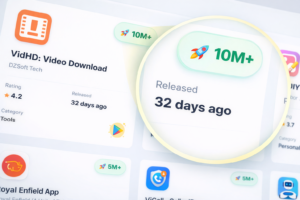
TRENDING APPS by RankMyApps is my tool I wish I’d created it earlier. It tracks recently launched mobile apps that are exploding with installs—basically showing you what’s working right now. Instead of analyzing apps with 10 million downloads (too late), you’re seeing apps that went from 0 to 100k in weeks. That’s where the insights are.
Other tools worth checking:
- App Annie (now data.ai) – Enterprise-level analytics, pricey but comprehensive
- Sensor Tower – Good for tracking installs and revenue estimates
- AppFigures – Solid for competitive keyword research
Social Media & Communities
Don’t underestimate the obvious:
- Product Hunt – New apps launching daily with real user feedback
- Reddit (r/SideProject, r/Entrepreneur, niche communities)
- Twitter/X – Search for “just launched” or “new app”
- Indie Hackers – Founders sharing what’s working
I found one of my best ideas from a Twitter thread where someone complained about a problem. Turned out 200 people had the same complaint. That’s validation.
How to Analyze Trending Apps for Insights
Okay, you’ve found a trending app. Now what? Don’t just think “cool idea, I’ll copy it.” That’s how you waste months building a worse version of something that already exists.
Step 1: Download and Actually Use It
Obvious, but skip this and you’ll miss everything. Use the app for at least 3-5 days like a real user.
Ask yourself:
- What problem is this actually solving?
- What’s the core value proposition? (Hint: it’s usually not what they claim in marketing)
- What’s the first-time user experience like?
- Where do I get confused or frustrated?
- What would make me come back tomorrow?
Step 2: Read the Reviews (The 3-Star Ones)
Five-star reviews are useless (“Great app!”). One-star reviews are often rage (“DOESN’T WORK”). The gold is in 2-3 star reviews.
These users wanted to like the app. They saw the potential but hit friction. They’ll tell you exactly what’s missing:
- “Would be perfect if it had X feature”
- “Love the concept but the UI is confusing”
- “Crashes when I try to do Y”
I built an entire feature roadmap once from reading 100 three-star reviews of competitor apps.
Step 3: Identify the Unmet Need
Every trending app succeeds because it scratches an itch. But often, it creates new itches in the process.
Example: When AI image generators exploded, they solved “creating art without skills.” But they created a new problem: “organizing and managing hundreds of generated images.” Boom—opportunity for a gallery/management app.
Questions to ask:
- What does this app do well?
- What are users complaining about?
- What adjacent problems does using this app create?
- Who is this app NOT serving well?
Step 4: Study the Business Model
How are they making money (or planning to)?
- Freemium with paid upgrades?
- Subscription model?
- One-time purchase?
- Ad-supported?
Check their pricing. If they’re charging $4.99/month and reviews say “too expensive,” that’s a signal. Maybe there’s room for a cheaper alternative. Or maybe there’s room for a premium version at $19.99 that actually delivers pro features.
Turning Observations Into Viable Product Ideas
You’ve analyzed a dozen trending apps. Your head is full of observations. Now you need to turn that into something buildable.
The “Better/Cheaper/Faster” Framework
Don’t just clone. Differentiate on at least one axis:
Better:
- More features
- Better UX
- More reliable
- Better design
Cheaper:
- Lower price point
- Free tier that’s actually useful
- One-time purchase vs. subscription
Faster:
- Quicker to get value
- Simpler onboarding
- Faster performance
Example: I saw a trending project management app that was feature-rich but overwhelming. I built a stripped-down version for solopreneurs that did 20% of the features but was 10x easier to use. That focus worked.
The Niche-Down Strategy
Take a horizontal trending app and make it vertical.
Examples:
- General meditation app → Meditation app for developers
- Budgeting app → Budgeting app for freelancers
- AI writing tool → AI writing tool for real estate agents
Niche-down usually means:
- Less competition
- Clearer marketing
- Higher willingness to pay
- Easier to reach your audience
The “Opposite” Play
Sometimes the best opportunity is doing the opposite of what’s trending.
When everyone was building complex productivity systems, someone built Bear (a simple markdown notes app) and made millions. When dashboards got cluttered, Notion went minimalist (at first).
Ask: What’s the contrarian take on this trend?
Validation: Before You Build Anything
I’ve built apps nobody wanted. Don’t be me.
The Landing Page Test
Takes 4 hours, costs $0-50:
- Create a simple landing page describing your idea
- Add an email signup form
- Run cheap ads or post in communities
- See if anyone actually signs up
If you can’t get 100 email signups, you probably can’t get 100 customers. Adjust or kill the idea.
The Pre-Sale Test
Even better: try to sell it before building it.
“But I don’t have a product yet!”
Exactly. Offer early access at a discount. If people pay, you’ve validated demand. If they don’t, you saved yourself 6 months.
I once “sold” 30 lifetime licenses to an app that didn’t exist. Built it in 2 months because I knew people wanted it. That accountability and validation were priceless.
Talk to Real Humans
Find 10 people in your target market (not friends—strangers from Reddit, Twitter, communities). Ask:
- Do you use apps like X?
- What frustrates you about them?
- Would you pay $X for something that did Y?
You’ll learn more in 10 conversations than in 10 months of guessing.
Common Mistakes (I’ve Made Most of These)
Mistake 1: Copying Instead of Improving
Cloning a trending app doesn’t work. You’re late, under-resourced, and offering nothing new.
Fix: Find the gap. What did they miss? Who did they ignore?
Mistake 2: Chasing Fads
Some trends are real (remote work tools). Some are fleeting (Clubhouse clones). Learn the difference.
Red flags for fads:
- No clear business model
- Driven purely by hype/FOMO
- Retention is terrible (everyone tries it once, then leaves)
Mistake 3: Ignoring Distribution
You built a better version. Great. How will anyone find it?
Successful trending apps usually have:
- Built-in virality (social features, referrals)
- Strong SEO/ASO (app store optimization)
- Community/audience pre-launch
- Paid acquisition that actually works
Don’t skip distribution planning. It’s half the battle.
Mistake 4: Building for Everyone
“This app is for anyone who wants to be productive!”
That’s nobody. Narrow your focus. You can expand later once you have traction.
Putting It All Together: A Real-World Example
Let me walk you through how I’d use this process today:
- Spot the trend: I notice AI avatar generators are trending (apps making profile pictures from your photos)
- Research: I download the top 5, use them, read reviews. Common complaint: “Takes too long to generate” and “Can’t customize styles enough”
- Find the gap: These apps serve consumers. But what about professionals? LinkedIn headshots are expensive ($200+)
- Niche down: Build “Professional AI Headshots for Remote Workers”—faster generation, business-appropriate styles, LinkedIn integration
- Validate: Create landing page, run $50 in Facebook ads to remote worker groups, see if anyone pays $19 for early access
- Build or pivot: If validation works, build the MVP. If not, try a different angle
See how trending apps were the starting point, not the final product?
Final Thoughts
The best app ideas aren’t random lightning strikes. They come from pattern recognition—seeing what’s working, understanding why it’s working, and finding the adjacent opportunity.
Trending mobile apps are your free market research. They show you where attention is going, where money is flowing, and where customers are still unsatisfied.
Your job isn’t to copy. It’s to learn, adapt, and build something 10x better for a specific group of people who desperately need it.
Now go find an app that’s trending, tear it apart, and build something better.