Table of Contents
- Why Most App Ideas Fail Before They Even Launch
- The Mindset Shift: Stop Brainstorming, Start Observing
- Method 1: Mining Your Own Frustrations
- Method 2: Watching What’s Already Working
- Method 3: Listening to Communities Where People Complain
- Method 4: Spotting Gaps in Existing Solutions
- How to Validate Before You Build
- Common Mistakes Developers Make
- Final Thoughts
Why Most App Ideas Fail Before They Even Launch
Here’s an uncomfortable truth I learned after building three failed apps: most developers (including past me) don’t have an idea problem. We have a validation problem.
I spent six months building a “revolutionary” note-taking app in 2022. Beautiful UI, smooth animations, local-first architecture—the whole nine yards. I launched it to crickets. Turns out, nobody wanted another note-taking app, no matter how pretty mine was.
The issue wasn’t my execution. It was that I started with a solution looking for a problem, not the other way around. Finding good app ideas in 2026 isn’t about having a “eureka” moment in the shower. It’s about identifying real problems that real people are willing to pay to solve.
This guide will show you how to find those problems systematically, so you don’t waste months (or years) building something nobody wants.
The Mindset Shift: Stop Brainstorming, Start Observing
Most advice on finding app ideas starts with brainstorming sessions, mind maps, and “think outside the box” exercises. That’s backwards.
Good app ideas rarely come from sitting in a room trying to be creative. They come from noticing patterns in the real world:
- What tasks do you see people doing manually that could be automated?
- What products do people use despite hating them?
- What complaints come up repeatedly in your industry or community?
The best founders I know don’t “think up” ideas. They notice opportunities that others walk past every day. Your job is to become better at noticing.
Method 1: Mining Your Own Frustrations
Start here because it’s the lowest-hanging fruit. What genuinely annoys you in your daily workflow?
I built a small tool last year that auto-generates API documentation from TypeScript types. Not because it was a “billion-dollar idea,” but because I was tired of manually keeping docs in sync with code. I mentioned it on Twitter, and 50 developers asked for access within 24 hours.
The filter: Your frustration needs to be shared by others and significant enough that people would pay to fix it.
Ask yourself:
- Do I complain about this problem regularly?
- Have I tried existing solutions and found them lacking?
- Would I pay $10-50/month to make this pain disappear?
If yes to all three, you might be onto something.
Pro tip: Keep a “friction log” for two weeks. Every time something in your workflow feels unnecessarily hard, write it down. You’ll be surprised how many recurring patterns emerge.
Method 2: Watching What’s Already Working
Here’s a strategy that’s worked consistently for indie developers: don’t reinvent the wheel, just build a better version for a specific niche.
Look at what apps are gaining traction right now. Not what’s already huge (competing with Notion is suicide), but what’s showing early momentum. According to App Annie’s State of Mobile report, the most successful apps often come from identifying existing categories with proven demand and serving an underserved segment better.
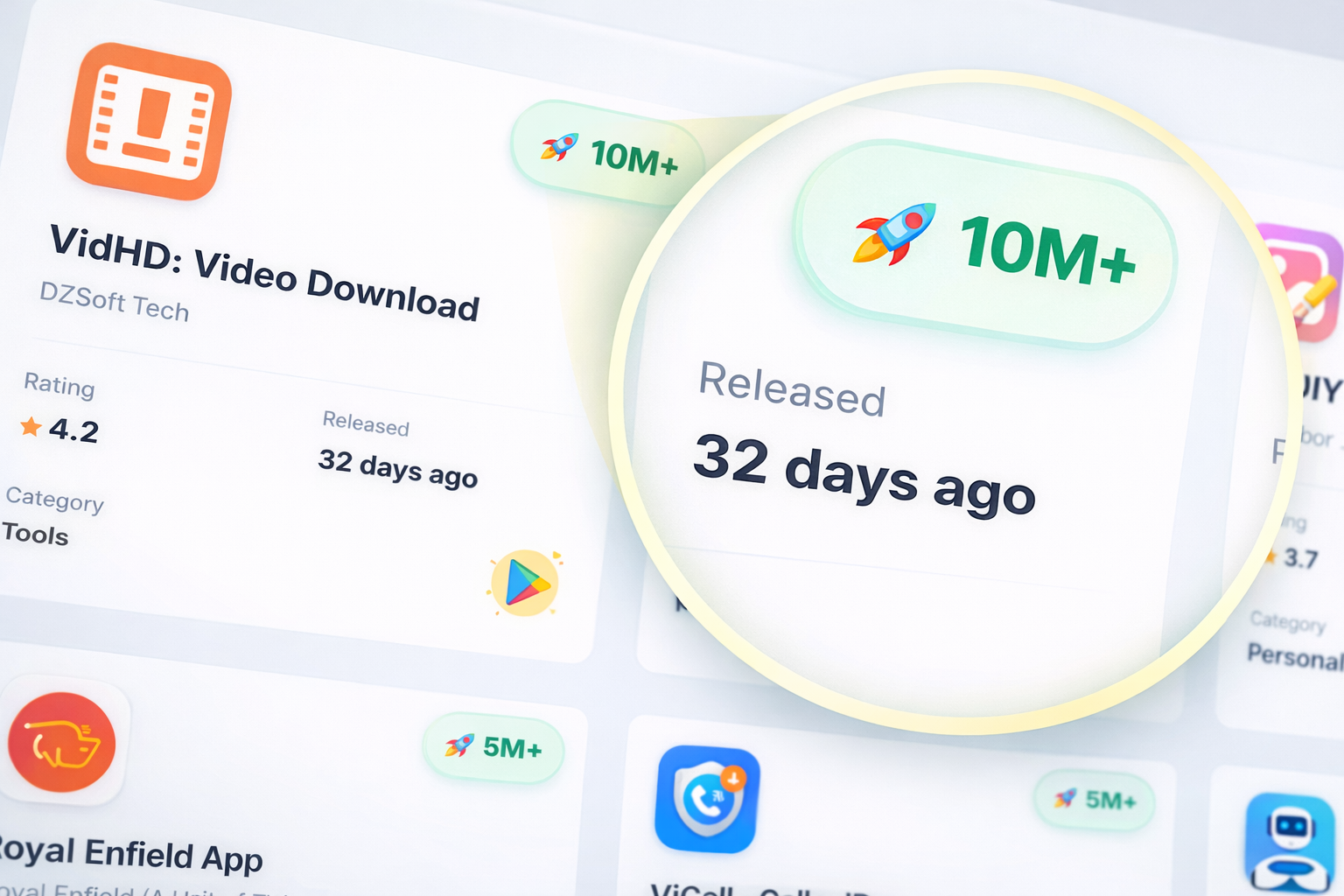
One tool I’ve found helpful for this is Trending Apps—it surfaces recently launched mobile apps that are experiencing rapid growth in installs. Instead of guessing what might work, you can see what is working based on actual download data. This helps you spot emerging trends before markets get saturated.
For example, when I noticed several budgeting apps for freelancers gaining traction in early 2024, I didn’t build another generic budgeting app. I built one specifically for freelance designers who invoice in multiple currencies. Much smaller market, way less competition, and users who actually cared about the specific features I built.
The strategy:
- Identify apps gaining momentum in a category you understand
- Read their reviews to see what users love and hate
- Build a focused version that solves the “hate” parts for a specific audience
This isn’t copying—it’s strategic positioning.
Method 3: Listening to Communities Where People Complain
The internet is full of people complaining about their problems. Your job is to listen.
I spend 30 minutes every morning scanning these places:
- Reddit (especially r/SaaS, r/Entrepreneur, industry-specific subreddits)
- Indie Hackers (people literally posting what they’re struggling with)
- Hacker News “Ask HN” threads
- Twitter/X (search for phrases like “I wish there was an app for”)
- Discord communities in your niche
Look for patterns. When you see the same complaint show up in three different communities, that’s a signal.
Last year, I noticed developers constantly asking for “a simple way to add auth to Next.js projects without the enterprise bloat of Auth0.” That complaint appeared 20+ times across different threads. Someone eventually built Clerk (which raised millions), but there’s still room for simpler, cheaper alternatives.
What to look for:
- Complaints that start with “Why isn’t there…”
- Long threads where people share hacky workarounds
- Questions about “best tool for X” that have no satisfying answers
Method 4: Spotting Gaps in Existing Solutions
Every successful product leaves gaps. Usually on purpose—they’re optimizing for 80% of users and ignoring edge cases.
But those edge cases? They’re often entire market segments.
Take project management tools. Asana and Monday.com dominate, but they’re built for corporate teams. There’s a huge gap for:
- Solo developers who need something lighter
- Creative agencies that need client-facing views
- Construction companies that need offline-first capabilities
How to spot gaps:
- Use the leading tool in a category
- Note everything it doesn’t do well
- Check reviews on G2 or the App Store to see if others notice the same gaps
- Build specifically for the people being underserved
I know a developer who built a $30K/month MRR business by creating a “simple CRM for real estate photographers.” He didn’t compete with Salesforce. He built exactly what one tiny niche needed and nothing more.
How to Validate Before You Build
Here’s the part most developers skip, and it kills them.
You don’t validate an idea by asking “Would you use this?” Everyone says yes to be polite. You validate by getting people to commit before you build.
Validation tactics that actually work:
The Landing Page Test
Create a simple page explaining your app (use Carrd or Webflow). Add an email signup. Run $100-200 in Google or Reddit ads targeting your audience. If you can’t get 50 signups at less than $3 per signup, your idea might not have legs.
The Pre-Sale Test
Even better: sell it before you build it. “This app launches in 60 days. Get lifetime access for $49 if you buy now.” If people won’t pay $49 for something that doesn’t exist yet, they definitely won’t pay when there are alternatives.
The Concierge MVP
Do manually what your app would do automatically. If you’re building a tool to automate social media scheduling, offer to do it manually for 5 clients for $100/month. If no one bites, automation won’t save the idea.
I wasted 4 months building a Chrome extension before realizing I could’ve tested the concept in 2 days with a landing page. Don’t be like me.
Common Mistakes Developers Make (And How to Avoid Them)
Mistake #1: Building for Yourself Only
Just because you need it doesn’t mean it’s a business. You need at least 10,000 other people with the same problem who can afford to pay.
Mistake #2: Ignoring Market Size
A perfectly executed app in a market of 500 people is still a bad business. Use Google Keyword Planner to estimate search volume for related terms. If fewer than 1,000 people are searching monthly, reconsider.
Mistake #3: Picking Markets You Don’t Understand
I tried building a tool for dentists once. I know nothing about dentistry. It failed because I couldn’t speak their language or understand their real workflow problems. Build in markets you have access to or experience in.
Mistake #4: Waiting for the “Perfect” Idea
Perfect ideas don’t exist. Good enough ideas executed well beat perfect ideas that never ship. Start small, ship fast, iterate based on feedback.
Mistake #5: Forgetting About Distribution
How will people discover your app? If your answer is “SEO” or “it’ll go viral,” you need a better plan. Think about distribution from day one. Can you reach your target users through a specific subreddit, Slack community, or newsletter?
Using Real Data to Find Opportunities
One advantage modern developers have is access to actual market data. You don’t need to guess what’s working.
Beyond tracking trending apps to spot growth patterns early, pay attention to:
- Download velocity (apps gaining installs quickly indicate real demand)
- Review sentiment (what users love vs. what they complain about)
- Category shifts (new categories emerging in app stores)
When multiple apps in the same category start trending simultaneously, that’s usually a sign of a growing market, not a saturated one. For example, when I noticed four AI writing assistants all gaining traction in Q3 2024, it didn’t mean “don’t build another one.” It meant “demand is expanding faster than supply.”
The key is finding where demand exists but solutions are still mediocre.
What Makes an Idea “Good” in 2026?
Times change. What worked in 2015 doesn’t work now. Here’s what makes an app idea viable today:
✓ Solves a clear, painful problem (not a nice-to-have)
✓ Targets a specific, reachable audience (not “everyone”)
✓ Can be validated in under 2 weeks (not 6 months of assumptions)
✓ Has a realistic path to first 100 users (not “hope it goes viral”)
✓ Can be built as an MVP in 1-3 months (not a 2-year roadmap)
✓ Faces weak or outdated competition (not Google or Microsoft)
If your idea checks these boxes, you’re in good shape.
Final Thoughts
Finding good app ideas isn’t about waiting for inspiration. It’s about training yourself to notice opportunities, validate quickly, and execute before someone else does.
The best time to start was yesterday. The second best time is today.
Stop overthinking. Pick one method from this guide. Spend a week on it. If you find one idea worth validating, you’re ahead of 90% of developers who never start.
And remember: you don’t need a revolutionary idea. You need a real problem, a specific audience, and the discipline to ship. Everything else is details.
Now go build something people actually want.