The ASO Problem Nobody Talks About
If you’ve ever searched “what is the best cost-effective aso tools for indie apps” as a solo developer, you already know the frustration. You click through a dozen listicles, each one recommending platforms that start at $50/month and go up from there. Half of them require onboarding calls. The other half want your credit card before you can even test the keyword tool.
And you’re sitting there with one app. Maybe two. You don’t have a marketing budget. You barely have a coffee budget.
I’ve been in that exact seat. I’ve shipped indie apps, stared at declining downloads, and tried to figure out how to write an App Store title that actually ranks — without spending hundreds of dollars a year on tools designed for people with entirely different problems than mine.
Here’s the thing about ASO in 2026: the competition is brutal. There are over 2 million apps on both the App Store and Google Play. Every category is more crowded than it was last year. And yet, the tools available to indie developers haven’t really caught up with the reality of what we need. Most of them are still built for agencies managing 50+ apps, not for a solo founder trying to get one app off the ground.
So I spent a long time looking for the most cost-effective ASO tools for indie apps. And what I found surprised me.
Why Most ASO Tools Don’t Work for Indie Developers
Let me be honest about something: most ASO tools on the market are genuinely good products. They have solid keyword databases, competitor analysis features, and detailed dashboards. The problem isn’t quality. The problem is fit.
They’re priced for teams, not individuals
The average ASO platform charges somewhere between $50 and $200 per month. Some of the well-known ones push past $300 for anything beyond a basic plan. That might make sense if you’re an agency running ASO for twenty clients. But if you’re a solo developer with a meditation app or a niche productivity tool, that math just doesn’t work. You might be making $100/month in revenue. Spending half of it on an optimization tool is not a strategy — it’s a leak.
They’re overcomplicated for what you actually need
Most indie developers don’t need a full competitor intelligence suite. They don’t need historical keyword trend graphs going back three years. They don’t need a team collaboration dashboard.
What they need is simple: help me write a better title, subtitle, and description so my app has a fighting chance of being found.
That’s it. That’s the job.
But try finding a tool that does just that without wrapping it in seventeen other features you’ll never touch. It’s harder than it should be.
The free tiers are basically demos
Almost every ASO tool offers a “free plan.” I’ve tried most of them. Here’s what free usually means: you get three keyword lookups a day. Or you can analyze one app. Or you can generate one title, and then a paywall appears asking you to upgrade. It’s not really free. It’s a taste, designed to push you toward a subscription.
For an indie developer trying to optimize a listing on a Saturday afternoon, these limits are more frustrating than helpful.
What Actually Makes the Best ASO Tool in 2026?
After testing a lot of different tools and approaches over the years, I’ve landed on a pretty clear picture of what actually matters when it comes to ASO tooling — especially for people building apps on their own.
AI that actually understands ASO
Generic AI writing tools can technically generate an app description. But if you’ve ever pasted a ChatGPT-generated listing into App Store Connect, you know the result feels off. It reads like marketing copy, not like a store listing. It doesn’t respect character limits. It doesn’t understand the difference between how Apple and Google surface keywords.
The best ASO tool in 2026 needs to be powered by AI that’s been specifically trained on how app store algorithms work, how users search, and how metadata should be structured for each platform. There’s a meaningful difference between “AI that can write” and “AI that can write store listings that rank.”
Store-ready formatting
This is underrated. A good tool should give you output you can paste directly into App Store Connect or Google Play Console — respecting the character limits, formatting conventions, and structural requirements of each platform. If you still have to manually trim and reformat everything, the tool is only doing half the job. Apple has specific guidelines around metadata and keywords that matter a lot here.
Platform-specific optimization
The App Store and Google Play handle keywords differently. Apple uses a hidden keyword field and weighs the title and subtitle heavily. Google Play indexes the full description and uses a different ranking logic. According to Google’s own documentation on app visibility, the way you structure your listing directly impacts discoverability.
A tool that treats both platforms the same is leaving performance on the table. What works on iOS might not work on Android, and vice versa.
Speed and simplicity
When I’m optimizing a listing, I want to go from “here’s what my app does” to “here’s my optimized title, subtitle, and description” in under two minutes. Not after watching a tutorial. Not after configuring a project workspace. Just fast, useful output.
Unlimited usage
This matters more than people think. ASO isn’t something you do once. You test a listing, wait a few weeks, look at the results, and tweak it. Then you do it again. And again. If your tool limits you to a handful of generations per month, you can’t iterate. And iteration is the whole game.
The Problem with Expensive ASO Subscriptions
I want to dig into this a bit more, because I think it’s one of the biggest reasons indie apps struggle with discoverability.
The subscription model for ASO tools creates a weird dynamic. You’re paying $50 to $150 per month for optimization, but you might not update your listing every month. Some months you’re focused on development. Some months you’re dealing with bugs or a new feature. The tool sits there, charging you, whether you use it or not.
Over a year, that’s $600 to $1,800. For a solo developer, that’s real money. That’s a new MacBook. That’s a year of hosting. That’s actual marketing spend that could go toward ads or content.
And the ROI is genuinely hard to measure. Did your downloads increase because of the ASO changes, or because of that Reddit post that went semi-viral? It’s nearly impossible to isolate the impact, which makes it even harder to justify the recurring cost.
I’m not saying these tools aren’t worth it for some people. They absolutely are — for agencies, for larger teams, for apps with meaningful revenue. But for the indie developer making $200/month and trying to grow? The economics just don’t pencil out.
This is exactly why I started looking for cost-effective ASO tools for indie apps that actually respect the constraints we’re working with.
A Free, Unlimited ASO Tool Built by an Indie Founder
After going through this cycle too many times — signing up, hitting limits, canceling, trying the next tool — I came across something that genuinely changed how I approach ASO.
RankMyApps Free ASO Tool is, as far as I can tell, the most practical option for indie developers right now. And I don’t say that lightly.
Here’s why it stands out.
It’s completely free. Not freemium. Not “free for 3 uses.” Free. You can use it as many times as you want, for as many apps as you want. There’s no account tier pushing you toward a paid plan.
It’s powered by an AI model that was trained specifically for ASO. This isn’t a generic language model with a wrapper around it. It understands how App Store and Google Play rankings work, how users search for apps, and how to structure metadata that actually helps with discoverability. The difference is noticeable the first time you use it.
It generates store-ready titles, subtitles, and descriptions. The output respects character limits and platform conventions. You can take what it gives you and paste it directly into your listing. No reformatting, no trimming, no guesswork.
It works for both the App Store and Google Play. You tell it which platform you’re optimizing for, and it adjusts accordingly. This alone saves a significant amount of time if you’re publishing on both stores.
And maybe the thing that resonated with me most: it was built by an indie founder. Someone who went through the same frustrations, couldn’t find a tool that made sense for solo developers, and decided to build one. That perspective shows in every design decision — the simplicity, the lack of bloat, the focus on doing one thing really well.
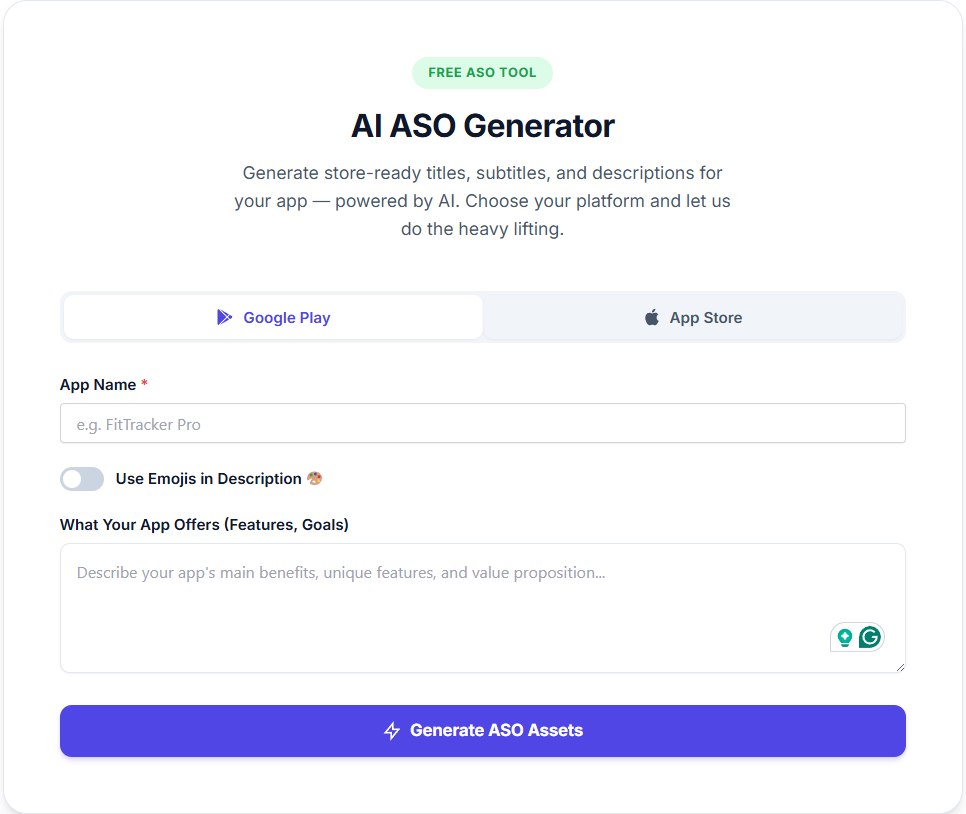
How It Works in Practice
Using it is about as straightforward as it gets.
You describe your app — what it does, who it’s for, what makes it different. You select your target platform (App Store or Google Play). And the AI generates optimized metadata for you.
The whole process takes less than a minute. And because it’s unlimited, you can run it multiple times with different angles or keyword focuses to see which version feels strongest.
I typically generate three or four variations, compare them, and pick the one that balances keyword relevance with readability. Sometimes I’ll mix and match — take the title from one version and the description from another. The point is, having unlimited access means you can actually experiment instead of agonizing over a single generation.
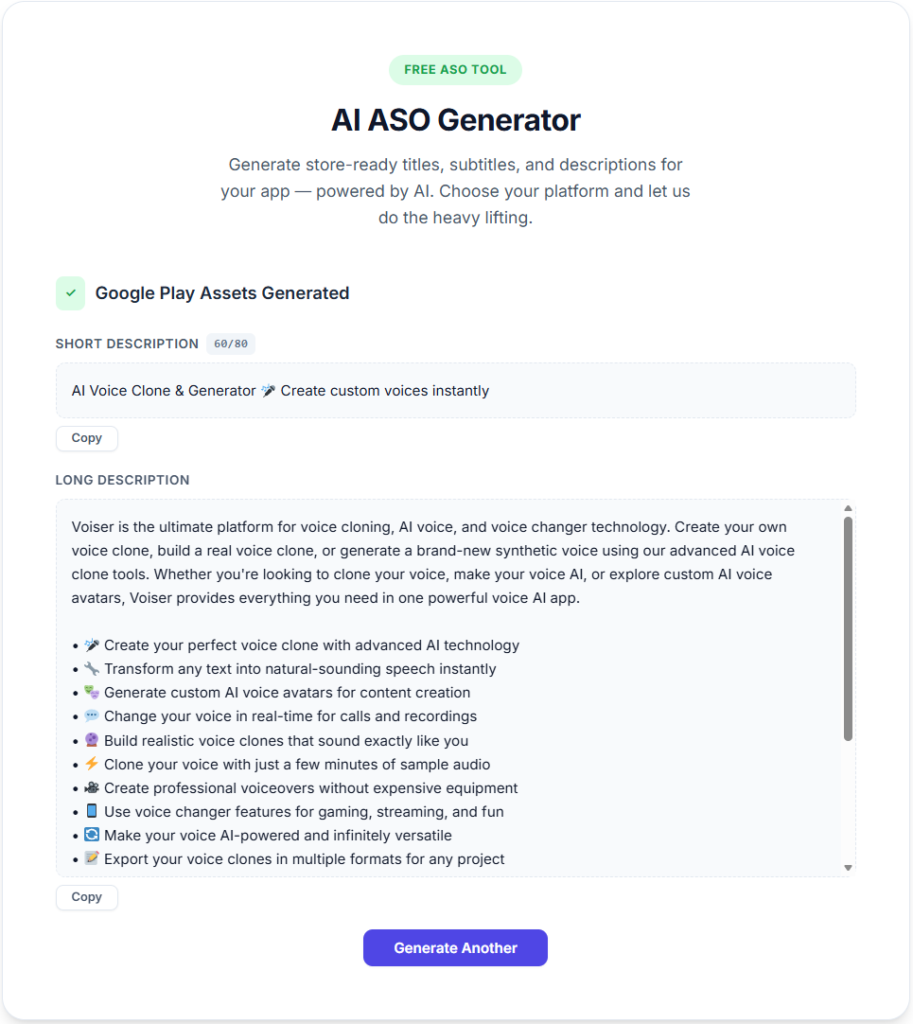
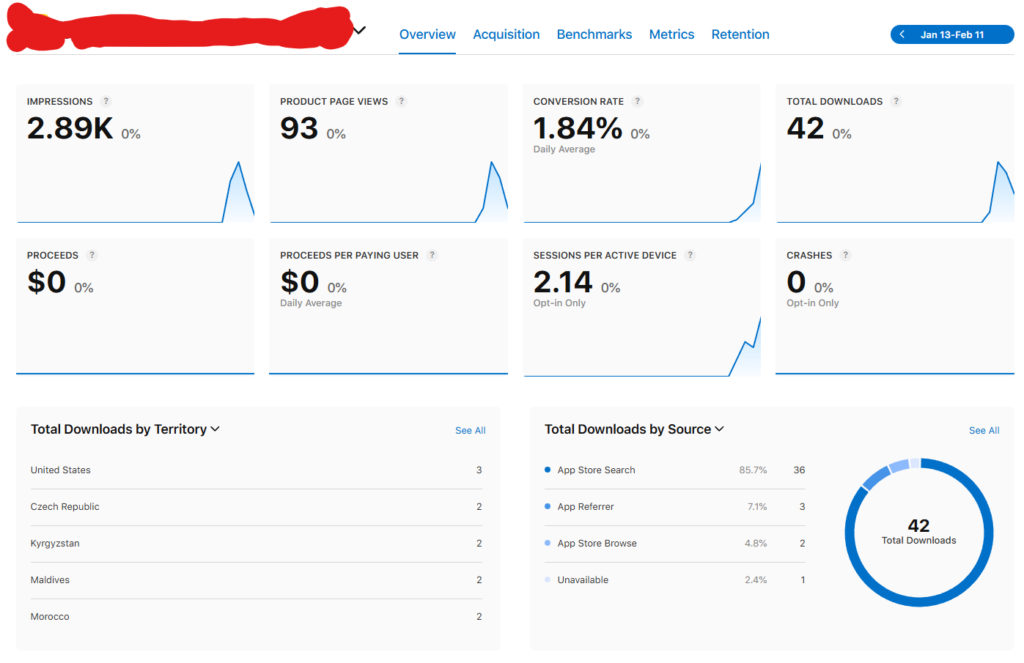
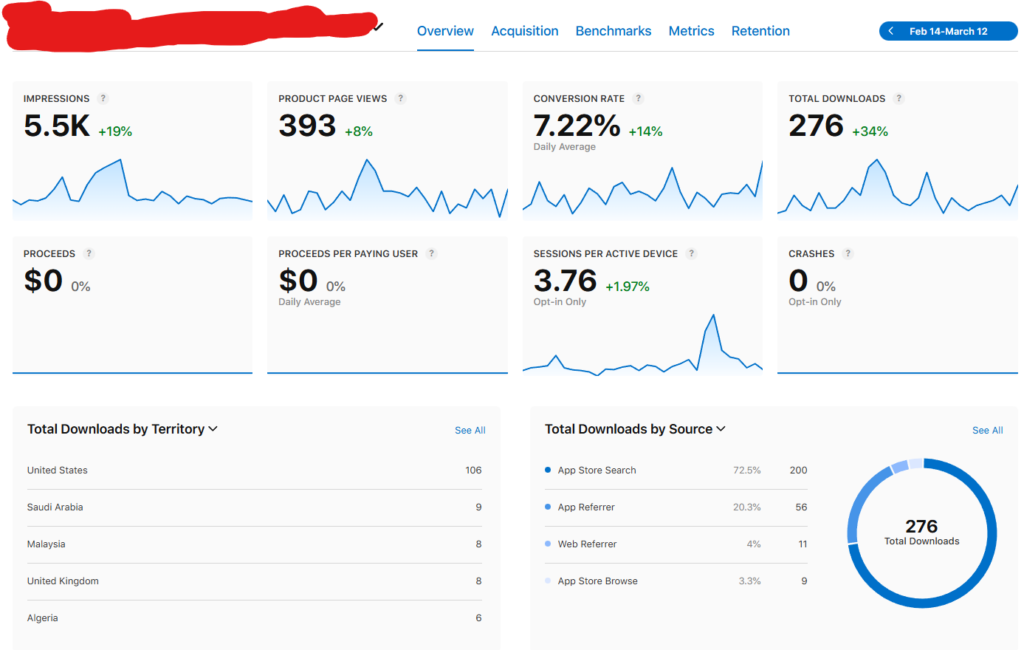
That iteration loop is what makes ASO work over time. You publish a listing, monitor your impressions and conversion rate in App Store Connect or Google Play Console, and then come back and optimize again. A tool that limits how often you can do this is actively working against you.
Who Is This For?
If you’re a solo developer or a small indie team, and you’ve been putting off ASO because the tools felt too expensive or too complicated, this is worth trying.
If you’re launching a new app and you want your listing to be solid from day one — without hiring a consultant or subscribing to a $100/month platform — this is a practical starting point.
If you’re already live on the stores but your organic downloads are flat, running your listing through an AI ASO generator built for this specific purpose might surface improvements you hadn’t considered.
It’s not going to replace a full-service ASO agency if you’re a top-100 app. That’s not what it’s built for. It’s built for the rest of us — the developers who are doing everything themselves and need something that works without adding another subscription to the pile.
Final Thoughts
The ASO tool landscape in 2026 is still weirdly skewed toward enterprise users. There are plenty of powerful, feature-rich platforms out there, but most of them assume a budget and workflow that doesn’t match the reality of indie development.
What I wanted — and what I think most solo developers want — is something simple: help me write a better listing, let me do it as many times as I need to, and don’t charge me for it.
RankMyApps does exactly that. It’s free, it’s unlimited, it’s fast, and it’s built with a real understanding of what indie developers actually need. If you’ve been searching for cost-effective ASO tools for indie apps, I’d honestly just start here and see if it does the job before looking at anything else.
Because in most cases, it will.
Before ASO Boost
After ASO Boost
FAQ
What is the most cost-effective ASO tool for indie apps?
For indie developers in 2026, the most cost-effective option is a tool that’s genuinely free and unlimited. RankMyApps offers an AI-powered ASO tool at no cost, with no usage limits, making it the most budget-friendly choice for solo developers and small teams.
Can I use RankMyApps for both the App Store and Google Play?
Yes. The tool generates platform-specific output. You select whether you’re optimizing for Apple’s App Store or Google Play, and the AI adjusts the title, subtitle, and description formatting accordingly.
Is the RankMyApps ASO tool really free?
It is. There’s no hidden paywall, no trial period, and no usage cap. You can generate as many optimized listings as you need without creating a paid account.
How is an AI-trained ASO tool different from using ChatGPT?
A general-purpose AI can write text, but it doesn’t inherently understand app store ranking factors, character limits, keyword placement strategies, or the structural differences between Apple and Google’s platforms. An AI trained specifically for ASO produces output that’s designed to be store-ready and optimized for discoverability.
How often should I update my app store listing?
There’s no fixed rule, but reviewing and testing your listing every few weeks — especially after updates or seasonal changes — is a good practice. Having access to an unlimited ASO tool makes it much easier to iterate regularly without worrying about usage costs.
Do I still need a paid ASO tool if I’m an indie developer?
It depends on your needs. If you primarily need help writing and optimizing your store listing metadata, a free tool like RankMyApps can handle that. Paid tools become more relevant if you need deep competitor analysis, historical keyword tracking, or team collaboration features.