I remember the exact moment I realized I had wasted six months of my life.
I had just launched a habit-tracking app. The UI was polished, the onboarding was smooth, and the code was clean. I pushed the “Release” button on the Google Play Console, sat back, and waited for the users to flood in.
Day 1: 3 installs.
Day 7: 12 installs.
Month 1: 45 installs (mostly friends and family).
The problem wasn’t the code. The problem was that I had entered a market that was already suffocated by giants. I was fighting a war I couldn’t win because I was looking at the wrong data. I was looking at what was already popular, rather than finding recently launched apps that were quietly gaining traction.
In 2026, the App Store and Google Play Store are more crowded than ever. If you are an indie developer or a small team, you cannot afford to guess. You need to know which new apps are growing right now, not which apps were popular three years ago.
Here is the honest truth about how to find those hidden gems and validate your ideas before writing a single line of code.
Why Most Developers Fail at Finding Winning App Ideas
The biggest trap for developers is the “Top Charts” fallacy.
When looking for inspiration, most people open the App Store, click on “Top Charts,” and scroll through the top 100 Productivity or Utility apps. They see a PDF editor making millions and think, “I can build a better PDF editor.”
No, you probably can’t. Or rather, you can build a better product, but you won’t get the traffic.
Those apps at the top have established ASO (App Store Optimization) moats, massive ad budgets, and years of reviews. Trying to displace them is like trying to open a burger joint next to McDonald’s without a marketing budget.
The “Cool Idea” Syndrome
Another common failure point is building based on gut feeling. You see a cool technology—maybe a new AI wrapper or a specific widget—and you build it because it’s fun.
But without analyzing recently launched apps in that space, you miss critical market signals. Are other people launching similar tools? Are those tools actually getting installs? Or are they launching and dying immediately?
If you don’t track the velocity of new entrants, you are flying blind.
What Actually Signals Early App Growth?
To succeed in 2026, you need to shift your focus from “Total Installs” to “Install Velocity.”
Total installs is a vanity metric for established players. Install velocity is the lifeblood of new apps. It tells you that a specific niche is heating up right now.
Here is what you should be looking for when analyzing the market:
1. The “Zero to Hero” Jump
You are looking for apps that were released in the last 30 to 90 days but have already crossed the 1,000 or 5,000 install mark. This is a massive signal. It means the developer found a vein of traffic—either through organic search demand (ASO) or a viral marketing loop.
2. Review Velocity vs. Total Ratings
Don’t just look at the 4.8-star rating. Look at the dates of the reviews. If a seemingly unknown app has received 50 reviews in the last week, something is happening. Real users are engaging. This is often a better signal than download numbers, which can be manipulated or delayed.
3. Category Movement
Watch the lower ends of the category charts. An app moving from rank #150 to #80 in the “Health & Fitness” category over a weekend is more interesting than the app sitting at #1. That movement represents momentum.
According to Apple’s App Store Optimization guidelines, relevance and user engagement are key ranking factors. When a new app spikes in rank, it means the algorithm has detected high engagement relative to its peers.
Why Expensive Market Intelligence Tools Don’t Help Indie Devs
For years, the standard advice was “buy a market intelligence tool.” You know the names—the big enterprise platforms used by Fortune 500 gaming companies.
I have used them. They are incredible pieces of engineering. But for an indie developer, they are fundamentally broken for three reasons:
- The Cost: Pricing often starts at $1,000+ per month. That is more than the burn rate of many indie projects.
- The Complexity: These tools are built for data analysts, not product builders. You get overwhelmed by dashboards showing retention curves and LTV projections for Candy Crush, when all you want to know is, “Is anyone downloading AI plant identifiers this week?”
- The Data Lag: Many enterprise tools focus heavily on historical data of big apps. They aren’t always great at surfacing the tiny app that launched 48 hours ago.
Indie developers need something lighter, faster, and specifically tuned to spot early opportunities.
A Smarter Way to Track Recently Launched Apps
This is exactly why we built the Trending Apps feature here at RankMyApps.
We were tired of manually scrolling through store pages and trying to hack together spreadsheets to spot trends. We needed a way to filter out the noise and see exactly what was hitting the market now.
We designed this tool specifically to solve the “validation problem.”
👉 Check out the Trending Apps feature here
Here is how it is different from the heavy enterprise tools:
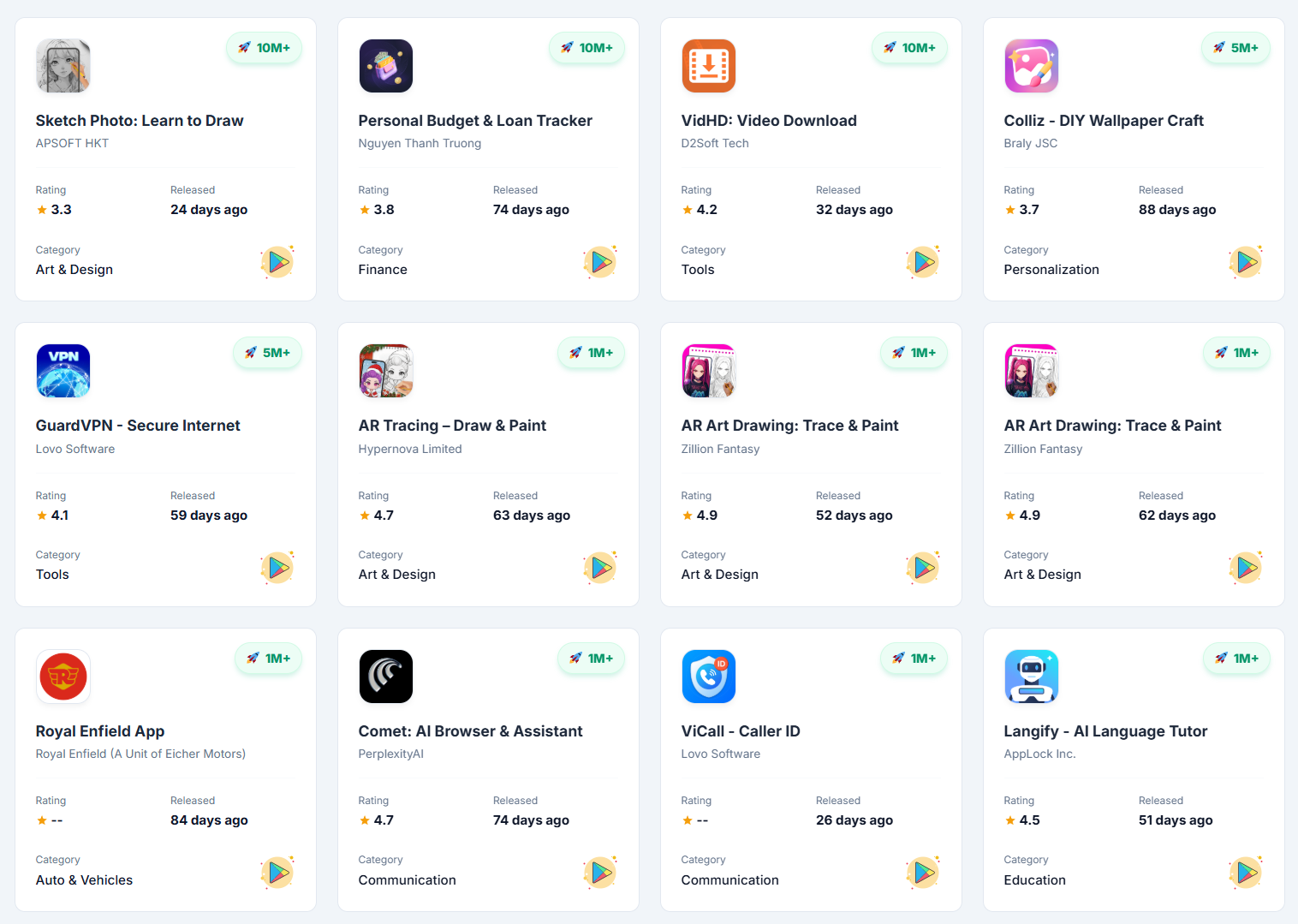
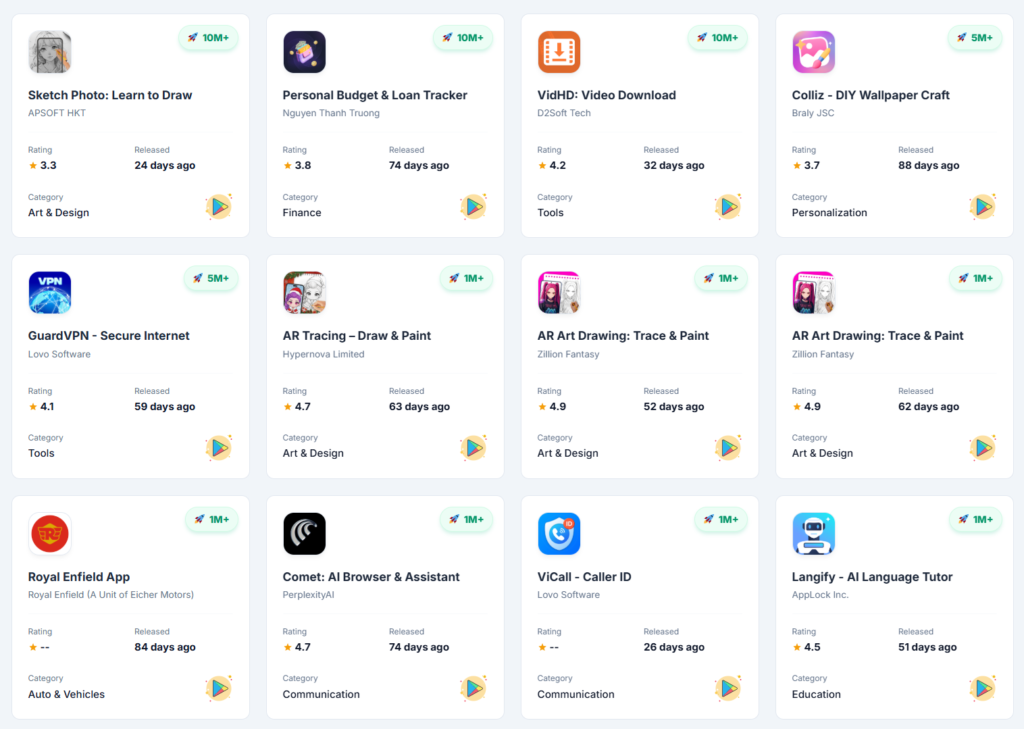
- Focus on Freshness: We prioritize apps that are actually new. You can filter specifically for recently launched apps to see what hit the store in the last week or month.
- Velocity Tracking: We highlight the apps that are gaining installs quickly relative to their age. This helps you spot the difference between a dead launch and a viral hit.
- Niche Discovery: instead of showing you the same top 10 apps everyone knows, our algorithms surface niche apps—specific calculators, specialized journals, niche AI tools—that are starting to bubble up.
It’s not about having more data; it’s about having the right data to make a decision. We built this to use internally for our own projects, and it became clear that other founders needed it too.
How to Use Recently Launched Apps to Validate Your Next Idea
So, you have access to the data. How do you actually use it to build a profitable app in 2026?
Here is the workflow I use to validate ideas without wasting money.
Step 1: Filter by “New” and “Growing”
Go to the Trending Apps page. Set the filter to show apps released in the last 60 days. Then, sort by growth or estimated installs.
You are looking for anomalies. Look for apps that have simple icons, maybe not the best UI, but are somehow getting downloads.
Step 2: Identify the “Gap”
Once you find a recently launched app that is growing, download it. Use it.
Then, go to the reviews. This is your gold mine.
Ignore the 5-star reviews. Look for the 3-star and 2-star reviews.
Users will tell you exactly what is missing:
- “I like this, but I wish it had dark mode.”
- “Good concept, but the subscription is too expensive.”
- “It crashes when I try to export to PDF.”
This is your roadmap. You don’t need to invent a new category; you just need to find a growing category and fix the specific complaints users have with the current new entrants.
Step 3: Check the Monetization
Before you commit to building, check how these new apps are making money. Are they using subscriptions? One-time purchases? Ads?
If a recently launched app has aggressive paywalls and still has high install velocity, that is a massive validation signal. It means the pain point is strong enough that users are tolerating the friction.
Step 4: Analyze their ASO
Look at their keywords. Are they ranking for terms you didn’t think of?
You can cross-reference this with the Google Play Console Help documentation on store listing best practices. Often, these new apps succeed because they found a low-competition keyword that the big competitors ignored.
Conclusion
Building apps is hard. Building apps that nobody wants is heartbreaking.
The era of “build it and they will come” is over. In 2026, the developers who win are the ones who act like investigators first and coders second.
By focusing on recently launched apps that are gaining installs fast, you bypass the guesswork. You stop trying to predict the future and start reacting to what the market is telling you right now.
Use the tools available to you. validation doesn’t have to be expensive, but it does have to be data-backed.
Check out the RankMyApps Trending Apps feature today. It might just save you six months of building the wrong thing.
FAQ
How do I find new apps that were just released?
To find new apps, you can use the “New Releases” sections on the App Store or Google Play, but these are often personalized and limited. For a comprehensive view, use a dedicated analytics tool like RankMyApps that allows you to filter specifically for “recently launched apps” across specific categories to see what was published in the last 30 days.
What is a good install rate for a newly launched app?
For a purely organic launch without paid ads, getting 10–50 installs a day in the first month is a positive signal for a niche app. However, if you spot a competitor getting 100+ daily installs shortly after launch, they have likely tapped into a high-demand keyword or a viral loop.
How can I tell if a new app is fake or using bot installs?
Look at the review-to-install ratio. If an app has 10,000 installs in one week but zero reviews, or generic 5-star reviews with no text, it is likely using bot traffic. Genuine growth usually comes with a mix of ratings and specific user feedback.
Why should I look at recently launched apps instead of top charts?
Top charts are dominated by apps with massive budgets and years of history. “Recently launched apps” show you current market trends and low-competition opportunities where a new developer can actually compete and win.